The Antikythera Mechanism – Ancient Greece Built a Computer 2000 Years Ago.
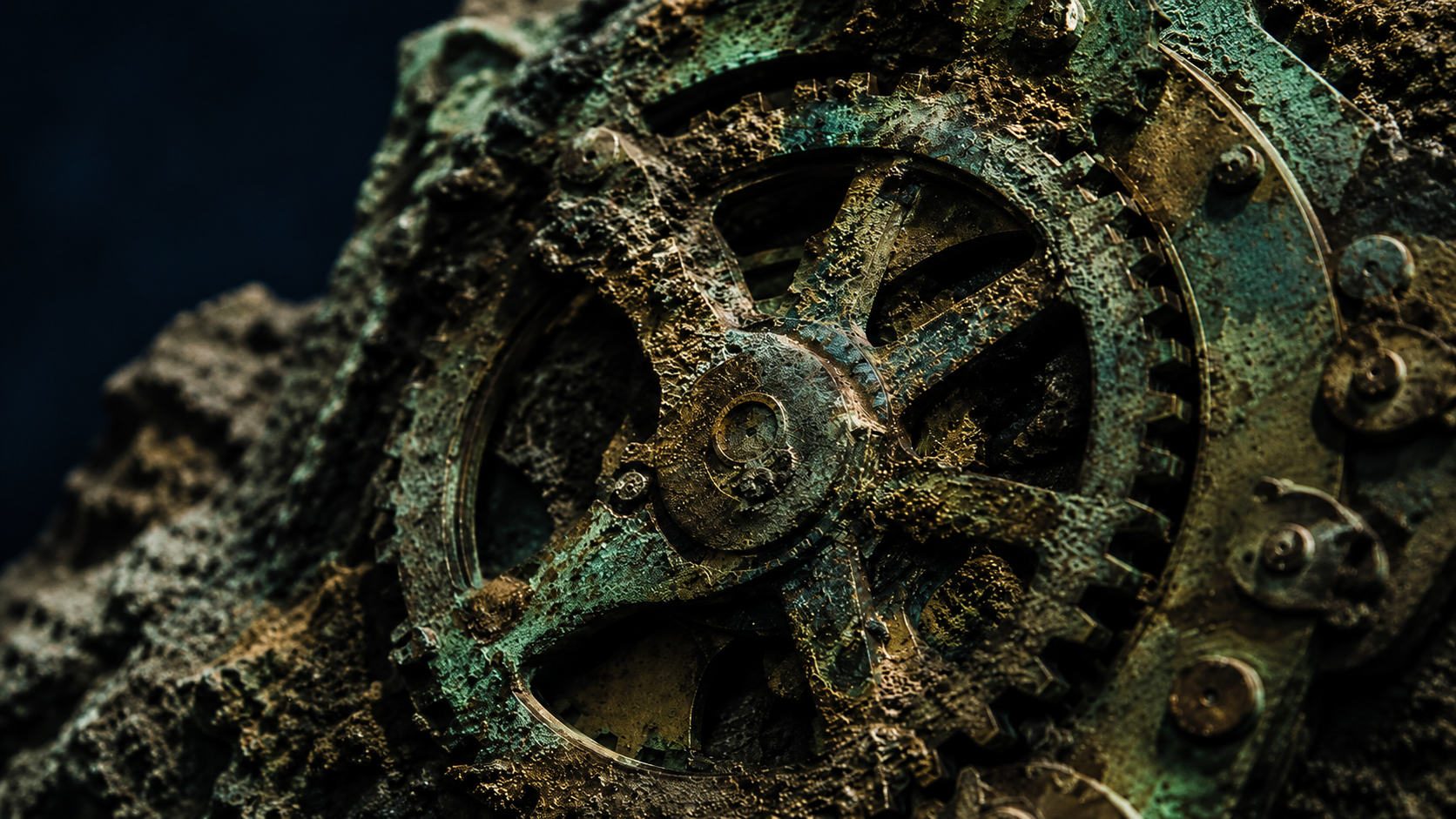
In 1901, a group of sponge divers sheltering from a storm off the Greek island of Antikythera made one of the most extraordinary discoveries in the history of archaeology. On the seafloor, at a depth of around 45 metres, lay the wreck of an ancient Roman cargo ship. Among the statues, coins, and glassware they pulled to the surface a corroded, unassuming lump of bronze encrusted with sea life, cracked by centuries of pressure, and almost completely unrecognisable.
It was nearly discarded. Nobody knew what they were looking at.
It would take decades of study, X-ray imaging, and the combined efforts of some of the world’s leading scientists to finally reveal what that lump of bronze actually was and when they did, it rewrote everything we thought we knew about the ancient world.
“The knowledge encoded inside that corroded bronze object would not be replicated by human civilisation for another 1,400 years.”
This is the story of the Antikythera Mechanism. And the deeper you go, the stranger it gets.

What Exactly Is the Antikythera Mechanism?
At first glance, even after restoration, the Antikythera Mechanism doesn’t look like much. A collection of fragmented bronze plates, roughly the size of a shoebox when assembled, darkened with age and incomplete after two millennia on the ocean floor.
But look closer, and the picture changes entirely.
Inside those fragments are at least 37 interlocking bronze gears. Some of them just 2 millimetres thin — machined with a precision that modern engineers still find remarkable. These gears weren’t decorative. They weren’t ceremonial. They were functional, interconnected, and designed to perform extraordinarily complex calculations.
Built somewhere between 150 and 100 BC, most likely in the Greek world, possibly Rhodes, possibly Corinth, the mechanism worked like this: you turned a hand crank on the side, and the device came alive.
It calculated the position of the sun and moon in the sky on any given date. It predicted solar and lunar eclipses years in advance. It tracked the cycles of the five known planets. It even followed the four-year cycle of the ancient Olympic Games.
“It was a working model of the cosmos. One you could hold in your hands.”
For context, the first mechanical clock wouldn’t appear in Europe until the 13th century AD. That was over 1,300 years later. The level of engineering sophistication required to build the Antikythera Mechanism was not supposed to exist in the ancient world. And yet, there it was. Sitting on the bottom of the Mediterranean, waiting.
The Discovery That Changed Everything
The wreck itself dates to roughly 60–70 BC, suggesting the mechanism was already decades old when the ship went down. It may have been a prized possession, a commissioned instrument, or part of a larger cargo of intellectual treasures being transported across the ancient world.
After its recovery in 1901, the mechanism sat largely unstudied in the National Archaeological Museum in Athens for decades. Early researchers noted the gears but couldn’t make sense of them. Its mechanical sophistication far exceeded anything archaeologists had previously discovered from that era.
It wasn’t until the 1950s that British historian Derek J. de Solla Price began the first serious scientific analysis of the device. His findings, published in 1959 and expanded throughout the following decades, were explosive: this was an analogue computer. A mechanical device of breathtaking complexity, built by ancient engineers whose mechanical sophistication stunned modern researchers.
Modern imaging techniques, particularly advanced X-ray tomography carried out by the Antikythera Mechanism Research Project in the 2000s, revealed even more. Hidden inscriptions which is a kind of instruction manual engraved into the device itself which were decoded, showing just how sophisticated the astronomical knowledge embedded in the mechanism truly was.
What the Inscriptions Revealed
The inscriptions described the mechanism’s functions in detail, including references to a 19-year lunar cycle (the Metonic cycle) used to align the solar and lunar calendars. This is a concept so mathematically precise that it is still used in calculating the date of Easter today.
There were also references to a 76-year cycle, a 223-month eclipse prediction cycle, and planetary motion calculations that required the ancient makers to understand and mechanically encode. The irregular, elliptical orbits of celestial bodies.
This was not guesswork. This was advanced, systematic, applied astronomy. Built in bronze. By hand.
The Question Nobody Can Answer
Here is where the story takes a turn that historians still struggle with.
If the ancient Greeks could build something this sophisticated in 100 BC, where are the others? Where are the blueprints, the workshops, the apprentices, the tradition? Where is the evidence of a civilisation that had been building towards this level of technological achievement?
The answer, as far as we can tell, is: nowhere.
The Antikythera Mechanism is unique. In all of recorded history, in all the archaeological excavations carried out across the ancient world, No directly comparable surviving device has ever been discovered.
The next mechanism of equivalent mechanical complexity doesn’t appear in the historical record for another 1,400 years in the form of medieval European clockwork.
“No blueprints were left behind. No tradition. No descendants. The knowledge just vanished.”
Some scholars suggest the mechanism was the product of a single extraordinary individual or school. Or even perhaps connected to the famous astronomer Hipparchus, whose mathematical models of lunar motion closely match the device’s calculations. Others point to the ancient city of Rhodes, a known centre of astronomical study, as a likely origin point.
But none of that explains the silence that followed. Whatever tradition produced the Antikythera Mechanism. Whatever school of thought, whatever workshop, whatever lineage of knowledge left no trace. It produced one object, lost it to the sea, and vanished from history entirely.

What This Tells Us About the Ancient World
The Antikythera Mechanism forces us to confront something uncomfortable: our model of ancient history as a slow, linear progression from primitive to sophisticated may be fundamentally wrong.
We tend to picture ancient civilisations as simpler, less capable versions of ourselves. Peoples who were intelligent, certainly, but limited by their tools and their understanding. The Antikythera Mechanism doesn’t fit that picture. It suggests instead that the ancient world contained peaks of knowledge and technological achievement that we have simply lost. Entire bodies of understanding that were never written down in a way that survived, never passed on in a tradition that endured, never replicated before they disappeared.
History, in other words, is not a straight line. It is a landscape of peaks and valleys of civilisations that rose to extraordinary heights and then fell, taking their knowledge with them.
There are forgotten truths buried in our past or in this case, drowned and just waiting to be found.
The Antikythera Mechanism is the most dramatic example of this we have ever found. But it raises a question that is impossible to ignore once you’ve asked it: how many others are there? How many discoveries, inventions, and bodies of knowledge were lost in the great collapses of the ancient world and in the burning of the Library of Alexandria, in the fall of Rome, in the slow erosion of civilisations that left no written record?
We don’t know. We may never know. But the mechanism sitting in its glass case in Athens is proof that the answer to that question is almost certainly: more than we think.
You Can See It For Yourself
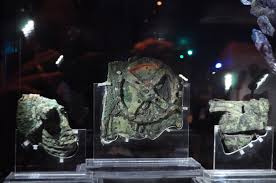
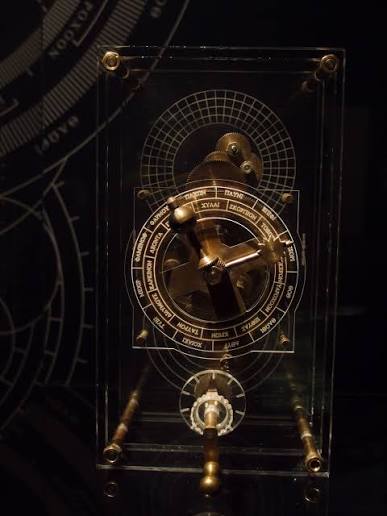
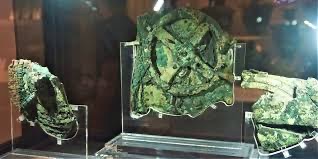
The Antikythera Mechanism and what remains of it is on permanent display at the National Archaeological Museum in Athens, Greece. Fragment A, the largest surviving piece, shows the gear train clearly. The museum also displays a working reconstruction that demonstrates how the device would have functioned in its complete form.
If you ever find yourself in Athens, it is worth going out of your way to stand in front of it. Not because of what it is which is a corroded collection of bronze fragments behind glass, but because of what it represents.
It is proof. Tangible, physical, undeniable proof that the ancient world was more sophisticated than we were told. That knowledge can be lost. That history has gaps we haven’t yet filled. And that somewhere out there on other seafloors, under other deserts, buried beneath other cities, there are more answers waiting.
The ancients were smarter than we were told. The mechanism is the proof.
Keep Exploring
At After Eden, we believe that the most extraordinary stories aren’t found in textbooks — they’re found in the gaps between them. The Antikythera Mechanism is one of those stories. And it’s far from the only one.
If this is the kind of history that makes you see the ancient world differently, you’re in the right place. We cover the discoveries, the mysteries, and the forgotten truths that mainstream history tends to leave out — from biblical archaeology to lost civilisations, from ancient technology to the events that shaped the world before recorded memory.
Subscribe to the After Eden YouTube or Follow us on Facebook using the social media links below for daily videos.
Ancient Worlds. Forgotten Truths. Eternal Questions.